TERMS OF REFERENCE (ToR)
Selection of a Lead Expert in Legal and Institutional Analysis
Activity A1.3: Conducting a Study on Gaps and Barriers to Access to Environmental Justice
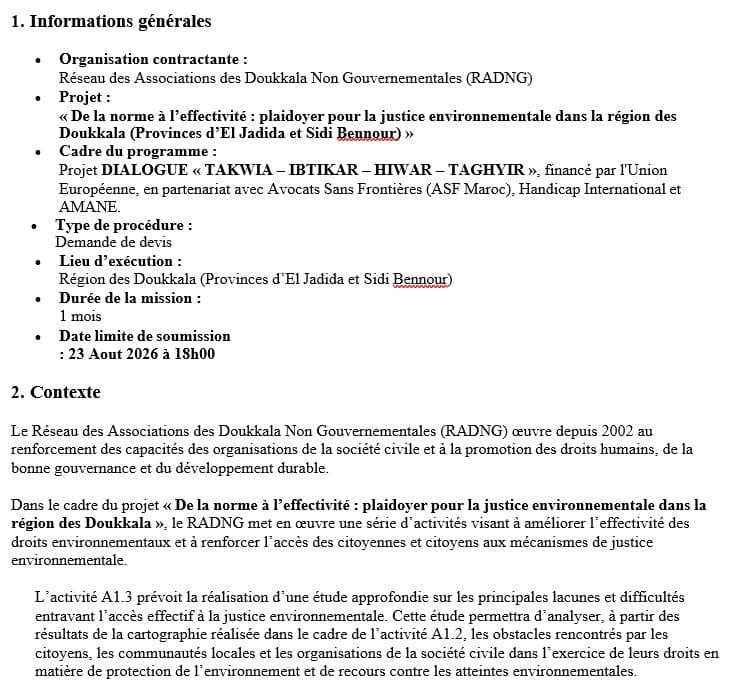
1. General Information
Contracting Organisation:
Network of Doukkala Non-Governmental Associations (RADNG)
Project:
“From Legal Standards to Effective Implementation: Advocacy for Environmental Justice in the Doukkala Region (Provinces of El Jadida and Sidi Bennour)”
Programme Framework:
DIALOGUE Project “TAKWIA – IBTIKAR – HIWAR – TAGHYIR”, funded by the European Union, in partnership with Avocats Sans Frontières (ASF Maroc), Handicap International and AMANE.
Type of Procedure:
Request for Quotations.
Place of Assignment:
Doukkala Region, particularly the Provinces of El Jadida and Sidi Bennour.
Duration of the Assignment:
One month.
Deadline for Submission:
23 August 2026 at 6:00 p.m.
---
2. Background
The Network of Doukkala Non-Governmental Associations (RADNG) has been working since 2002 to strengthen the capacities of civil society organisations and promote human rights, good governance and sustainable development.
Within the framework of the project “From Legal Standards to Effective Implementation: Advocacy for Environmental Justice in the Doukkala Region”, RADNG is implementing a series of activities aimed at improving the effectiveness of environmental rights and strengthening citizens’ access to environmental justice mechanisms.
Activity A1.3 provides for the implementation of an in-depth study on the main gaps and difficulties hindering effective access to environmental justice. Based on the findings of the mapping conducted under Activity A1.2, this study will analyse the barriers faced by citizens, local communities and civil society organisations in exercising their rights related to environmental protection and seeking remedies against environmental harm and violations.
The study will focus in particular on identifying and analysing legal, administrative, institutional, procedural, financial and practical barriers that may limit access to existing complaint, monitoring, appeal and redress mechanisms.
It will also examine the conditions for accessing environmental information, applicable deadlines and procedures, costs related to administrative and judicial procedures, as well as the difficulties faced by local populations and civil society actors in providing support and following up on cases.
Particular attention will be given to institutional gaps and possible overlaps of responsibilities among the different actors involved in handling environmental complaints and litigation.
The study will also seek to identify needs relating to information, awareness-raising, legal support and capacity building for the relevant stakeholders.
The findings of the study will provide a documented diagnosis of the main barriers to access to environmental justice and formulate operational recommendations aimed at improving the effectiveness of existing mechanisms.
The findings will also serve as a basis for RADNG’s advocacy activities and for the design of future environmental legal assistance initiatives, with priority given to identified gaps and the needs of populations and communities most exposed to environmental harm and violations.
---
3. Purpose of the Assignment
The purpose of this assignment is to select a Lead Expert in Legal and Institutional Analysis, acting as an individual consultant, consultancy firm or research office, responsible for conducting an analytical mapping of complaint, monitoring, appeal and redress mechanisms related to environmental justice in the Provinces of El Jadida and Sidi Bennour.
---
4. Objectives of the Assignment
Overall Objective
To contribute to strengthening access to environmental justice through improved knowledge of existing legal and institutional mechanisms.
Specific Objectives
- Identify and analyse the main gaps and barriers that hinder effective access of citizens, communities and civil society organisations to environmental justice.
- Assess the conditions of access to administrative, judicial and institutional complaint, monitoring, appeal and redress mechanisms related to environmental matters, particularly in terms of information, procedures, costs, deadlines and support.
- Analyse legal, administrative, institutional, financial and territorial barriers that may limit the effective exercise of environmental rights and access to available justice mechanisms.
- Identify the difficulties faced by local populations and civil society organisations when filing, following up and processing complaints and appeals related to environmental violations, with particular attention to vulnerable populations and areas located far from competent services.
- Assess the effectiveness and accessibility of existing mechanisms, highlighting shortcomings in institutional coordination, information, transparency and the monitoring of complaints and appeals.
- Formulate operational recommendations aimed at addressing identified gaps and strengthening access to environmental justice, particularly through advocacy, awareness-raising, capacity building and the establishment of future environmental legal assistance initiatives by RADNG.
---
5. Expected Results
- An in-depth study on gaps in access to environmental justice is completed, documenting the main barriers faced by citizens, communities and civil society organisations.
- The main legal, administrative, institutional, financial and territorial barriers are identified and analysed, together with their impact on effective access to environmental justice mechanisms.
- Difficulties related to access to, use of and follow-up of complaint and appeal mechanisms are documented, particularly regarding information, costs, deadlines, procedures and legal support.
- Institutional shortcomings and dysfunctions are identified, particularly problems related to coordination, communication, monitoring and processing of environmental complaints and appeals.
- The needs of citizens, communities and civil society organisations regarding access to environmental justice are documented, with particular attention to vulnerable populations and territories with limited access to competent services.
- Concrete and operational recommendations are formulated to improve the accessibility, effectiveness and efficiency of environmental justice mechanisms.
- The study findings serve as a reference base for RADNG’s advocacy activities and for the design of future legal assistance and support initiatives for victims of environmental harm and violations.
- A final study report is prepared and disseminated among relevant stakeholders in order to promote institutional dialogue and contribute to strengthening access to environmental justice.
---
6. Tasks and Responsibilities
6.1 Documentary and Legal Analysis
The Expert shall:
- Identify and analyse the main national and, where applicable, international legal instruments relating to environmental rights and access to environmental justice.
- Review existing procedures and mechanisms for complaints, monitoring, administrative appeals and judicial litigation related to environmental harm and violations.
- Analyse the mandates and responsibilities of the relevant institutions, as well as the distribution of roles among the different administrative, judicial and institutional actors.
- Identify legal provisions that may constitute barriers to access to environmental justice, particularly regarding admissibility, deadlines, costs, legal standing and access to information.
- Analyse available case law and decisions, where accessible, in order to identify trends, recurring difficulties and possible inconsistencies in the handling of environmental cases.
- Review existing reports, studies, assessments and data produced by public institutions, civil society organisations, research institutions and technical partners.
- Identify gaps and shortcomings in the legal and institutional framework that may limit the effective exercise of environmental rights.
- Link the findings of the documentary analysis with field-level findings in order to develop a comprehensive understanding of barriers to access to environmental justice.
- Develop initial recommendations aimed at strengthening the legal, institutional and procedural framework and improving access of citizens and civil society organisations to environmental justice mechanisms.
6.2 Analysis of Gaps and Barriers to Access to Environmental Justice
- Identify the main legal and institutional gaps.
- Analyse barriers to accessing environmental justice mechanisms.
- Formulate recommendations to improve access to environmental justice mechanisms.
6.3 Analysis of Access Conditions
- Identify the legal and administrative conditions for accessing the various mechanisms.
- Analyse costs, deadlines, documentary requirements and procedural constraints.
- Identify barriers faced by local populations, particularly vulnerable groups.
6.4 Drafting and Validation
- Develop the analytical mapping.
- Produce a critical analysis of existing mechanisms.
- Formulate operational recommendations.
- Present the findings during validation and feedback workshops organised by the project.
---
7. Deliverables
The Consultant shall provide:
- A validated methodological note.
- A study on gaps in access to environmental justice.
- An analytical report.
- A final report incorporating comments and observations.
- The final report.
- An executive summary in French and Arabic.
---
8. Required Profile
The Expert shall meet the following criteria:
- Master’s or Doctorate degree in Law, Political Science, Public Administration or an equivalent field.
- Proven experience in legal or institutional analysis or environmental governance.
- Good knowledge of the Moroccan legal framework relating to the environment, territorial authorities and access to justice.
- Experience in conducting institutional mapping and public policy analysis.
- Excellent analytical, synthesis and report-writing skills.
- Fluency in French and Arabic.
- Experience with programmes funded by international donors will be considered an asset.
---
9. Duration and Contractual Arrangements
- Duration of the assignment: One month.
- Type of contract: Service contract.
- Status: Individual consultant, consultancy firm or research office.
---
10. Financial Arrangements
- Payment shall be made in the form of professional fees.
- 50% upon signature of the contract.
- 50% upon approval of the final deliverables.
Travel, communication and logistical expenses, consultation workshops (venue, logistics and refreshments), as well as data processing and analysis costs, shall be fully borne by the service provider.
11. Application File
The application shall include:
- Detailed Curriculum Vitae.
- Expression of Interest.
- Methodological Note.
- Assignment work plan and timetable.
- Detailed financial offer in Moroccan Dirhams, including VAT (MAD TTC).
- References for similar assignments.
12. Eligibility Criteria
Applicants shall:
- Be legally registered.
- Demonstrate relevant professional experience.
- Have the required technical and scientific expertise.
- Be able to complete the assignment within the specified timeframe.
13. Evaluation Criteria
Offers will be evaluated based on the following criteria:
- Quality of the technical and scientific proposal.
- Experience of the service provider in legal and institutional studies.
- Relevance of the proposed methodology.
- Understanding of environmental justice issues and challenges.
- Financial offer.
14. Submission Procedure
Email:
Deadline for receipt of offers:
23 August 2026 at 6:00 p.m.
15. Special Conditions
The service provider undertakes to:
- Comply with professional ethical principles.
- Guarantee the confidentiality of the information collected.
- Respect the values and principles of RADNG and the requirements of the project partners.
- Integrate a gender-sensitive, inclusive and disability-accessible approach.
- Respect the principles of participation and data protection.
16. Final Provisions
- RADNG reserves the right not to proceed with this call for consultation without being required to provide justification.
- The selected service provider shall comply with the contractual and technical requirements of the project partners, particularly Avocats Sans Frontières (ASF Maroc), in accordance with the provisions of the DIALOGUE Programme “TAKWIA – IBTIKAR – HIWAR – TAGHYIR”.